ALDEX CR Series
CR 9 Gel-type Strong Base Anion Exchange Resin
Aldex CR 9 is a gel-type (and Aldex CR 9 MP the macroporous version), strong base anion exchange resin used in the removal of PFAS (including PFOA and PFOS) and perchlorate from water and other solutions but primarily it is used for potable water applications. Aldex CR 9, supplied in its gel form is highly effective at removing contaminants from drinking water.
Aldex CR 9 Technical Bulletin: English (PDF)
Aldex CR 9 Safety Data Sheets: English (PDF) | Français (PDF)
Physical Chemical Properties
| Polymer Structure: | Gel, crosslinked |
| Functional group: | Tributylamine |
| Physical Form: | Spherical beads |
| Particle Size (>98%): | 0.315 to 1.25 mm |
| Moisture Content: | 50 to 57% |
| Bulk Density: | 650 to 750g/l |
| Total Capacity: | ≥0.6 eq/L |
Recommended Operating Conditions
| Maximum Temperature (Cl-): | 60°C |
| Bed Depth: | 75 cm minimum |
| Service Flow Rate: | 8 to 40 BV/h |
| Backwash Flow Rate: | See Fig. 1 |
| Regenerant: | Sodium Chloride (NaCl) or Potassium Chloride (KCl) |
| Regenerant Strength: | 5 to 15%, usually 10% |
| Regenerant Flow Rate: | 3 to 8 BV/h |
| Regenerant Contact Time: | 15 to 60 minutes |
| Regenerant Dosage Level: | 30 to 240 g/l |
| Slow Rinse (Displacement) Flow Rate: | 3 to 8 BV/h |
| Slow Rinse Volume: | 2 to 4 BV |
| Fast Rinse Rate: | 8 to 40 BV/h |
| Fast Rinse Volume: | 4 to 8 BV |
| Inlet Water Limitations: Turbidity Free Chlorine | 1.0 ppm maximum 1.0 ppm maximum |
CR 9 Features
Very low color, taste or odor
Aldex CR 9 meets the requirements listed in paragraph 173.25 of the Food Additive Regulation of the U.S. Food and Drug Administration.
Performance
Aldex CR 9 adsorption capacity remains high even after regeneration.
Long Life
Strong and durable beads ensure long service life.
Reliability
Aldex Chemical has over 40 years of field usage by thousands of customers demonstrates the reliability of Aldex ion exchange resins, zeolites and other water treatment media.
Safety Information
A material safety data sheet is available for Aldex CR 9. Copies can be obtained from Aldex Chemical Co., LTD. Aldex CR 9 is not a hazardous product and is not WHMIS controlled.
Caution: Acidic and basic regenerant solutions are corrosive and should be handled in a manner that will prevent eye and skin contact. Before using strong oxidizing agents in contact with ion exchange resin, consult sources knowledgeable in the handling of these materials.
Backwash Characteristics
After each cycle, the resin bed should be backwashed at a rate that expands the bed 50 to 75 percent. This will remove any foreign matter and reclassify the bed. Fig. 1 shows the expansion characteristics of Aldex CR 9 in the chloride form.

Fig. 1 Bed Expansion vs Flow Rate at various degrees Celsius (C°)
Performance
Extensive, long-term comparative lab and pilot testing on Aldex CR 9 against several competitor’s products demonstrate that when using Aldex CR 9 to remove PFAS, the adsorption capacity of PFOA and PFOS was highly competitive as shown in figures 1A and 1B below.
Even after regeneration, the Aldex CR 9 resin continues its high-performance levels as can be seen in figures 2a and 2b below.

Fig. 1a and 1b Comparative testing of adsorption performance between Aldex CR 9 and other competitors (feed concentration 10 ug/L, flow rate 20 BV/h)
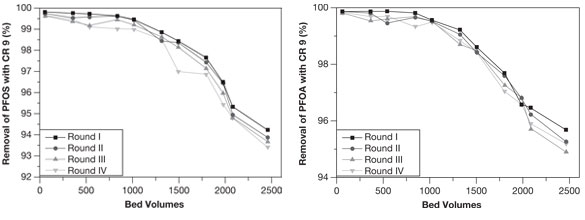
Fig. 2a and 2b Adsorption capacity after regeneration (feed concentration 50 ug/L, flow rate 20 BV/h).
Pilot Plant
Figure 4 at the right, shows recent pilot plant data on the effluent readings after using Aldex CR 9 for PFOA and PFOS remediation.
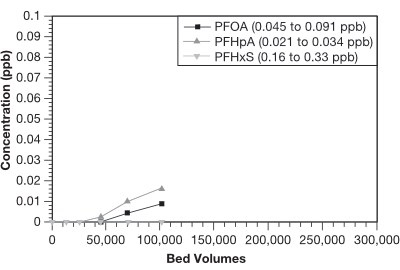
Fig. 4 Effluent readings after passing through Aldex CR 9