ALDEX CSR Series
Chromatographic Separation Resin: C106 (Ca/K)
Aldex C106 (Ca/K) is a gel-type, strong acid cation resin supplied in the Calcium ion (Ca2+) or Potassium ion (K+) form. It is specially designed as a universal media for the physical separation of ingredients for the food and beverage industry and is primarily used in simulated moving bed (SMB) chromatographic systems for the recovery and purification of high fructose corn syrup (HFCS) and high-purity fructose.
Aldex C106 (Ca / K) Technical Bulletin: Metric (PDF)
Aldex C106 Ca Cut Sheet: English (PDF)
Aldex C106 K Cut Sheet: English (PDF)
Physical Chemical Properties
| Resin Composition: | Gel styrene / divinylbenzene copolymer |
| Functional Group: | Sulfonic acid |
| Ionic Form as Shipped: | Calcium ion |
| Physical Form: | Amber, translucent, spherical beads |
| Total Capacity (H+ form): | ≥ 1.6 eq/L |
| Moisture Content (H+ form): | 48 to 53% |
| Particle Density: | 1.27 g/ml |
| Bulk Density | 820 g/l |
Recommended Operating Conditions
| Syrup Temperature (Ca2+ form): | 25ºC to 130ºC |
| Syrup pH: | 0 to 14 |
| Dissolved Oxygen Concentration:* Recommended: Maximum: | <0.1 ppm 1.25 ppm |
| Simulated Moving Bed Operation: | Annually with optimized tuning |
*Removing oxygen from both the feed streams and the elution water that goes into the chromatographic separation resin is strongly advised, as the process of limiting the oxygen concentrations will maximize the resin service life.
Aldex C106 (Ca/K) Features
Highest Recovery and Purity
Aldex C106 (Ca/K) resins provide the highest recovery and purity for starch-based sweeteners as well as the purification of polyols.
Uniform Particle Size
Aldex C106 (Ca/K) resins are strong acid cation resins manufactured in a process that produces an extremely uniform particle size.
Efficiency
The consistency of Aldex C106 (Ca/K) resins, with their rapid kinetic properties, provide improved efficiency in sweetener separations over that of standard-grade resins.
Very low color/taste/odor
Aldex C106 (Ca/K) resins meet the requirements for paragraph 173.25 of the Food Additive Regulation of the U.S. Food and Drug Administration.
Superior Physical Stability
The swift kinetics and highly uniform particle size provide resistance against bead breakage with ≥ 97% whole, uncracked beads.
Long Life
Strong and durable beads ensure long service life.
Safety Information
A material safety data sheet is available for Aldex C106 (Ca/K) resin. Copies can be obtained from Aldex Chemical Co., LTD. Aldex C106 (Ca/K) resin is not a hazardous product and is not WHMIS controlled.
Caution: Acidic and basic regenerant solutions are corrosive and should be handled in a manner that will prevent eye and skin contact. Before using strong oxidizing agents in contact with ion exchange resin, consult sources knowledgeable in the handling of these materials.
Aldex C106 (Ca/K) Properties
| Index Name | C106 (Ca) | C106 (K) |
|---|---|---|
| Mass Capacity | 4.5 mmol/g | 4.5 mmol/g |
| Moisture Content | 48 to 53% | 46 to 51% |
| Bulk density | 800 to 850 g/ml | 800 to 850 g/ml |
| Particle Size | 0.32mm to 0.38mm, 95% | 0.32mm to 0.38mm, 95% |
| Uniformity Coefficient | 1.1 | 1.1 |
Common Bead Size Distribution
Light Obscuration Instrument Particle Size
| Particle Diameter: | 320 to 380 μm | — |
| Broad Range: | >320 μm | ≥90% |
| Fine Beads: | <320 μm | ≤5% |
| Coarse Beads: | >380 μm | ≤5% |
Backwash Characteristics
Estimated bed expansion as a function of backwash flowrate at 77°F (25°C) is represented in Fig. 1. To find the flow rate necessary for the desired bed expansion at other water temperatures, this equation can be used:
FT = F77ºF [ 1 + 0.008 (TºF – 77) ], where F ≡ gpm/ft2
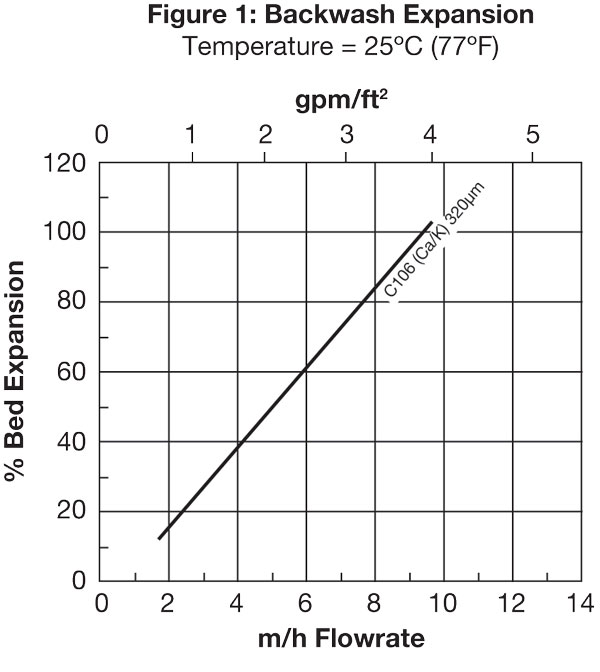
Bed Expansion vs. Backwash Flow Rate at 77°F
Pressure Drop
The estimated pressure drop as a function of service flowrate and concentration of 42% HFCS (50% and 30% D.S.) is represented in Fig. 2.
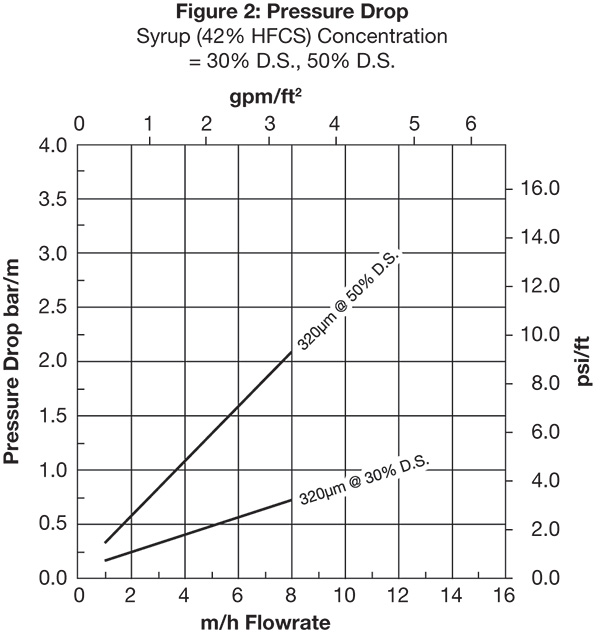
Fig. 2 Pressure Drop vs Flow Rate at various degrees Fahrenheit (F°) for Syrup (42% HFCS) Concentration equals 30% D.S., 50% D.S.
Thermal Expansion
Thermal expansion of Aldex C106 (Ca/K) as a function of temperature and ionic form is represented in Fig. 3.
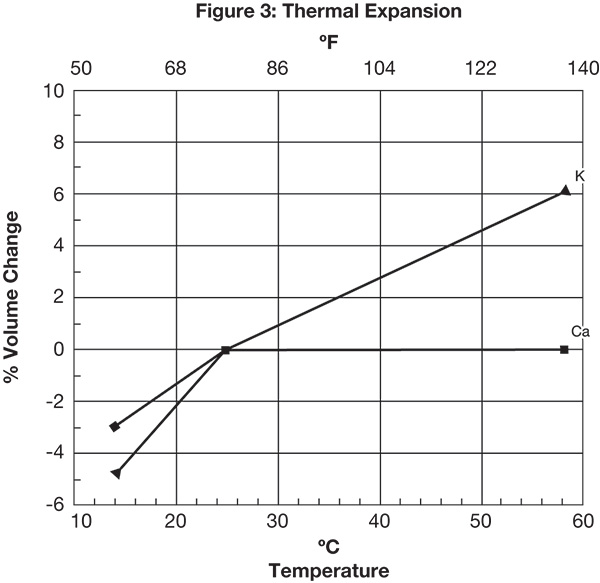
Fig. 3 Percent Volume Change vs Temperature
Applications
In addition to recovery and purification of sweeteners, this resin can be used in other specialty separations such as the production of high fructose corn syrup (HFCS) and high-purity fructose and the separation of polyols.